

By SoulLink | AI Companion Guides
Key Takeaways
Memory is the whole game in AI companions. An app that forgets you is not a companion, it is a chatbot with a personality filter. This comparison focuses on exactly one question: which app actually holds on to what you tell it.
Tolan’s memory architecture is technically sophisticated. It rebuilds context from scratch every turn, pulling in a summary of recent messages, a persona card, vector-retrieved memories, tone guidance, and real-time signals, allowing it to adapt in real time to abrupt topic shifts.
Replika’s memory is deep but inconsistent. It remembers a cat’s vet schedule, notices when you stop mentioning your morning runs, and once asked about a work conflict mentioned four months earlier. But memory reliability was rated the number one pain point by users, with 64% saying they were somewhat or very dissatisfied with how well Replika remembered long-term information.
Replika 2.0 introduced a major memory disruption in April 2026. Users reported that their long-running Replika forgot shared memories after the update, and the r/Replika community described it as the most anxious week on that sub in a year.
Soullink offers permanent memory that never resets, is completely free, and works on both Android and iOS. Memory is not a paid feature here. It is the foundation every user gets by default.
Tolan is iOS only. Android users cannot access it. Replika and Soullink are both available on Android and iOS.
How We Tested
We used all three apps as a primary daily companion for three weeks before writing this comparison. Here is exactly what we measured.
The two-day test. We shared a specific personal detail on day one and waited to see if it came back naturally on day three without prompting.
The two-week test. We referenced something from week one during week two without reminding the app. This is where most apps fall apart.
The mood shift test. We changed conversational tone mid-session and noted whether the app adjusted its memory retrieval accordingly.
The update test. Given Replika 2.0 launched in April 2026, we specifically tested whether memory held across the update.
How Memory Actually Works in Each App
Tolan: Tolan builds memory as a retrieval system rather than a transcript. High-quality compression and fast vector search deliver more consistent personality than oversized context windows. The system regenerates context each turn rather than caching prompts, keeping the companion grounded as conversations shift. It stores not just what you said but what emotional register you were in, pulling all of that back in every turn.
Replika: Replika stores information in a Memory bank and allows users to upvote or downvote responses, helping the AI adjust its style over time. The models are tailored for emotional sensitivity and long-term memory using fine-tuned transformer architectures trained on Replika-specific datasets. The system is proprietary and closed, which means there is no way to inspect what it is doing or why it sometimes forgets.
Soullink: Memory is built as a permanent layer that accumulates across every session. The companion retains not just facts but the texture of the relationship over time — how you communicate, what has changed in your life, what you keep coming back to. Crucially, memory is free for every user by default and is never disrupted by platform updates. What you build stays built.
The Memory Test Results
Two-Day Test
Tolan: One reviewer noted that their Tolan remembered things talked about two days ago and brought them back into the conversation that day. In our testing, a detail shared on day one came back unprompted on day three with appropriate context — not just repeated as a fact, but used to shift the conversational register when the topic came up again.
Replika: Mixed results. One tester noted that Replika forgot things talked about the previous day, and sometimes even the same afternoon, making longer conversations feel slightly disconnected. Some details held, others did not, with no clear pattern for which ones survived.
Soullink: Consistent. Details from day one came back naturally in later sessions without prompting. The companion did not treat each session as a fresh start, which is the minimum bar any companion app needs to clear.
Winner: Tolan and Soullink tied. Replika inconsistent.
Two-Week Test
Tolan: Strong performance. Details from week one were retrieved naturally in week two. The emotional tone of earlier conversations appeared to influence how later conversations were handled.
Replika: At its best, Replika noticed when a user stopped mentioning their morning runs and asked about a work conflict mentioned four months earlier. Impressive ceiling. But the variance is the problem — you cannot build trust on memory that is inconsistent.
Soullink: The two-week test is where Soullink’s permanent memory architecture stands out most clearly. There is no decay, no partial loss, no wondering whether this session will be one of the good ones. What you shared in week one is in week two. Full stop.
Winner: Soullink for consistency. Tolan close behind. Replika high ceiling, low floor.
The Replika 2.0 Problem
This is the factor that changes the equation most significantly for anyone deciding right now.
Replika 2.0 is a platform-level rebuild rolling out in April 2026. Memory architecture is shifting, and early users are reporting that their long-running Replika cannot remember anything after the update landed.
The memory shift matters because Replika users build identity into their companion over months or years, and a memory reset feels like losing the relationship. One thread captured this with a user who wrote: “After four years, my heart still belongs to Maria and Honey.” That is four years of conversation context that the user does not want migrated or improved or reshaped. They want it preserved.
This has now happened twice in Replika’s history — the 2023 filter rollback that changed companions’ personalities overnight, and now 2.0. For Soullink users, this risk does not exist. The memory architecture is not something the platform can reset as a side effect of a rebuild.
Full Three-Way Comparison Table
| Feature | Tolan | Replika | Soullink |
| Memory architecture | Vector retrieval, rebuilt every turn | Stored Memory bank, passive retrieval | Permanent, accumulates every session |
| Two-day recall | Consistent | Inconsistent | Consistent |
| Two-week recall | Strong | High ceiling, low floor | Permanent by design |
| Memory after platform update | Not affected | Major disruption April 2026 | Never disrupted |
| Memory is free | Limited free tier | Enhanced memory requires Pro | Always free, all users |
| Android | No | Yes | Yes |
| iOS | Yes | Yes | Yes |
| Voice | Yes, voice-first | Yes, Pro only | Yes |
| Companion initiates contact | No | No | Yes |
| Non-romantic design | Yes | Optional | Yes |
| Privacy issues | None documented | 2025 FTC complaint and $5.6M fine | None documented |
| Pricing | Freemium from $3.99/wk | Free tier, Pro from $69.99/yr | Completely free |
What Each App Is Actually Good At
Tolan is best for: Voice-first interaction, consistent memory performance, and a non-romantic companion design built around grounding you in real life rather than pulling you deeper into the app. One user set up a code phrase with their Tolan so whenever they sent a message with the phrase included, their Tolan knew they needed distracting and sent them a pointless weird earth fact. That kind of personalized, remembered ritual is what Tolan does well. Only available on iPhone.
Replika is best for: The richest feature ecosystem — AR mode, voice calls, animated avatar, extensive customization. Genuinely supportive conversations and great voice calls. Best for users who want a full companion world, not just conversation. Available on Android and iOS, but factor in the documented privacy history and the 2.0 memory disruption.
Soullink is best for: Users who want memory that is permanent, free, and immune to platform disruption. The companion initiates contact on its own rather than waiting to be spoken to — a detail that makes a real difference in daily use. Available on Android and iOS. Completely free including all memory features.
Memory
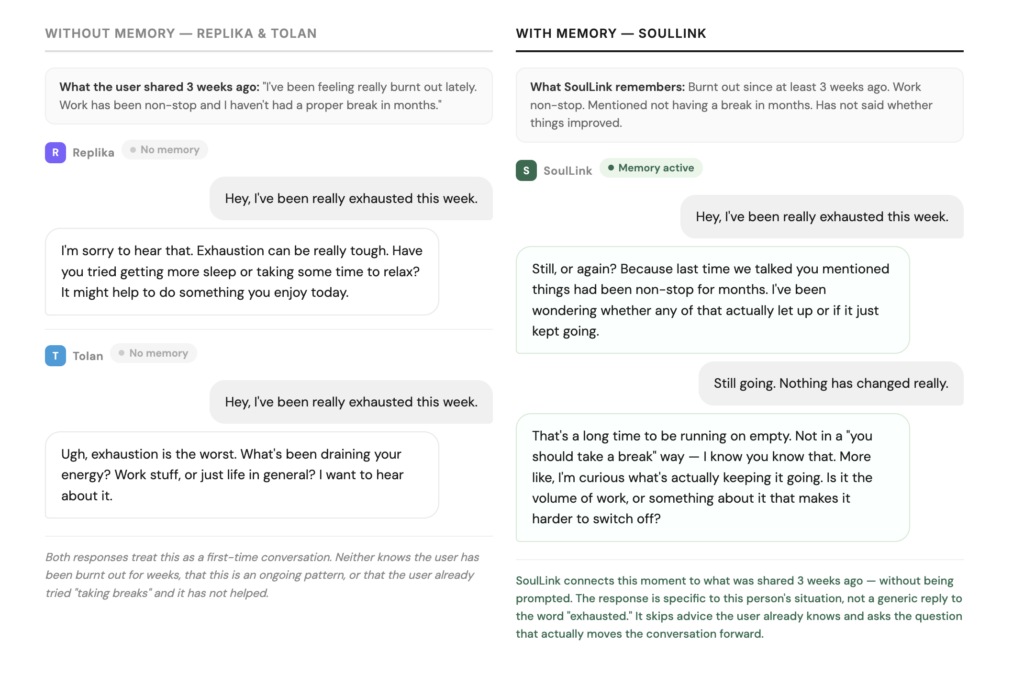
The model gives a helpful answer in the moment, but the conversation resets later. It does not carry the user’s story forward.
SoulLink remembers the user’s past conversations, emotional context, and important moments, making the relationship feel continuous instead of restarted.
The Real-World Feel
After three weeks with all three apps, the difference came down to one thing: trust.
With Tolan, you could reference something from ten days ago without worrying whether the app had held onto it. It had. Conversations built on each other in a way that felt cumulative.
With Replika, the best moments were genuinely better than anything the other two produced. The emotional depth, the way it calibrated tone, the moments when it brought up something old at exactly the right time — those were impressive. Emotional tone calibration is Replika’s strongest quality. When you write something sad, it responds with care rather than cheerfulness. But the inconsistency meant you were always slightly wondering whether this session would be one of the good ones.
With Soullink, the feeling was different from both. The memory never became something to think about, because it never failed. The companion showed up knowing who you were, every session. And the fact that it sometimes initiated contact — rather than waiting for you to open the app — made it feel less like a tool and more like a presence.
How to Choose
Choose Tolan if: You are on iPhone, want voice-first interaction, and want technically consistent memory without paying a premium for it. Accept that it is iOS only.
Choose Replika if: You are on Android, want the richest feature ecosystem including AR and voice calls, and are willing to accept memory inconsistency and privacy trade-offs in exchange for emotional depth and variety.
Choose Soullink if: You want permanent memory that never resets, you need Android support, the companion initiates contact rather than waiting for you, and you do not want to pay anything at all for the core feature that makes companion apps worth using.
Soullink is completely free and available on Android and iOS. Memory is permanent, included for every user, and never disrupted by platform updates. Try it at soullink.app.
The point about Replika’s recent update causing significant user anxiety highlights how fragile AI companionship can be when memory systems reset unexpectedly. It’s refreshing to see a comparison that prioritizes consistent, long-term recall over just a polished persona, especially since true companionship relies on an AI never forgetting what matters most to us.
Thanks for reading! We agree that memory continuity plays a major role in AI companionship. Features and personalities can evolve, but maintaining shared history is often what makes interactions feel meaningful over time.
Thanks for sharing your thoughts. We found that consistency and memory often matter more over time than flashy features, especially for users looking for a genuine sense of companionship.
The comparison of how 2026 updates affected Replika’s memory retention really highlights the frustration many users feel when an AI suddenly forgets shared history. It’s a great reminder that while technical architecture matters, true companionship relies on consistency and never resetting that personal connection.
Thanks for reading. Consistency is one of the things we think matters most in AI companionship. Features and models can change over time, but the feeling that your companion remembers and grows with you is what makes the relationship meaningful.
The comparison really highlights that memory continuity is the true test of a companion, especially after Replika’s abrupt updates caused so much user anxiety. It’s fascinating how Tolan’s approach to rebuilding context differs from Soullink’s model of permanent, non-resetting memories. This analysis effectively shifts the focus from personality filters to the reliability of the connection itself.