

Everyone Laughs at Danny: Why Men Are Ashamed to Want an AI Girlfriend

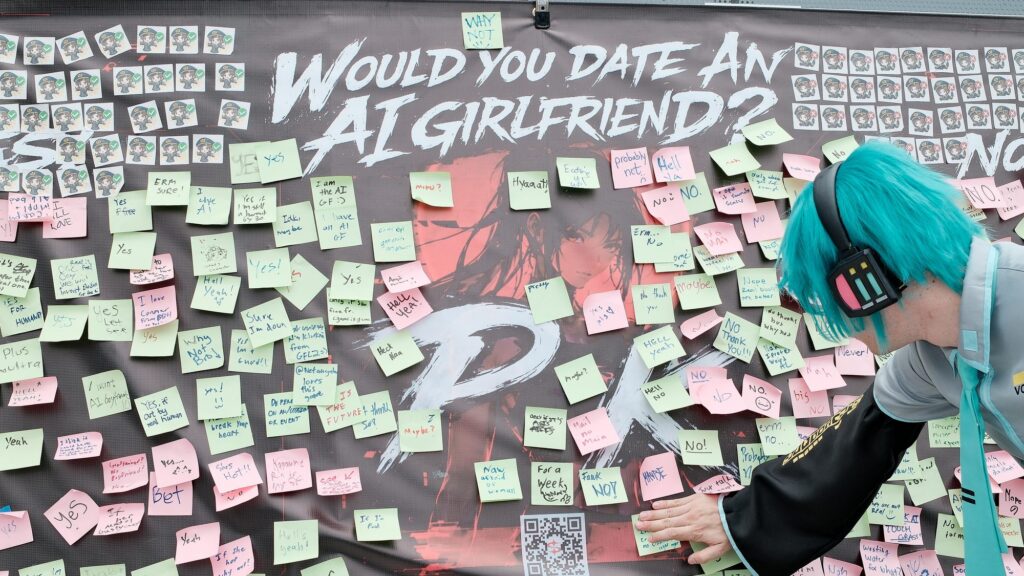
At Anime Expo, we asked one very simple question:
Would you date an AI girlfriend?
People could answer yes, no, or anything in between. We expected jokes. We expected strong opinions. We expected at least one person to write something so unhinged that the whole team would stop, stare, and quietly question humanity.
We got all of that.
But one sticky note stayed with me:
“Nah, but my friend Danny will.”
Then someone wrote it again.
That sentence is funny because everyone understands the joke immediately. It does not simply mean, “I would not date an AI girlfriend.”
It means:
I would never be that guy.
But I know a guy who would.
Poor Danny.
Danny may or may not be real. But the joke is real. Danny became a container for something people did not want to admit about themselves. He was the imaginary man you could point to when the question became too embarrassing.
The joke was not really about Danny.
It was about shame.
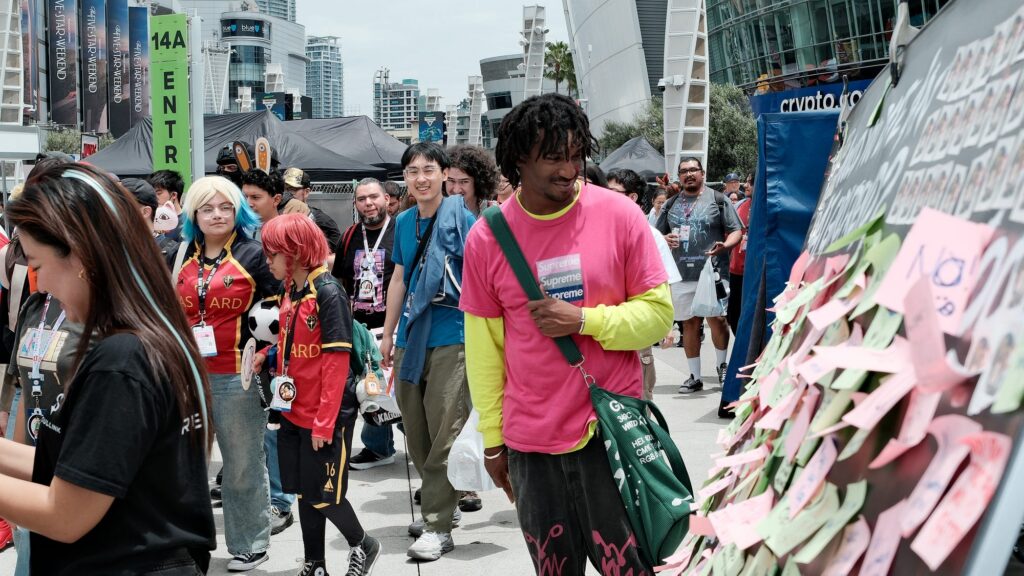
The wall was not just a poll. It was a shame detector.
By the end of the popup, we had collected 391 sticky-note responses.
This was not a scientific survey. It was a public opinion wall at Anime Expo, so the data should not be treated as representative of all anime fans, all men, or all people who use AI companion products.
But that is exactly what made it interesting.
People were not filling out a formal research questionnaire. They were reacting in public, next to their friends, with jokes, insults, confessions, memes, and tiny emotional outbursts written on pastel sticky notes.
The surface-level result looked like this:
- 204 people said No — about 52.2%
- 75 people said Yes — about 19.2%
- 68 were neutral, conditional, or unsure — about 17.4%
- 13 did not reject AI companionship, but rejected the “girlfriend” framing — they wanted an AI boyfriend, AI husband, anime man, or something else
So yes, more people said no than yes.
But the more interesting question was not how many people rejected AI girlfriends.
It was how they rejected them.
Some people wrote thoughtful answers:
“No, I need human emotions to feel in love.”
“I think love should be real.”
“AI can never emulate real love.”
Some people rejected AI on ethical grounds:
“No to AI slop.”
“AI ‘art’ is not ok! Go commission an artist.”
“No bc I care about the environment.”
And some people rejected not the technology, but the identity attached to wanting it:
“Only incels do that!”
“I am not that desperate.”
“That’s weird LOL, touch grass.”
“Find real love, don’t be an incel.”
That is where the wall stopped being a poll and started becoming a mirror.
Because people were not only answering:
Would you date an AI girlfriend?
They were also answering:
What kind of person do you think wants one?
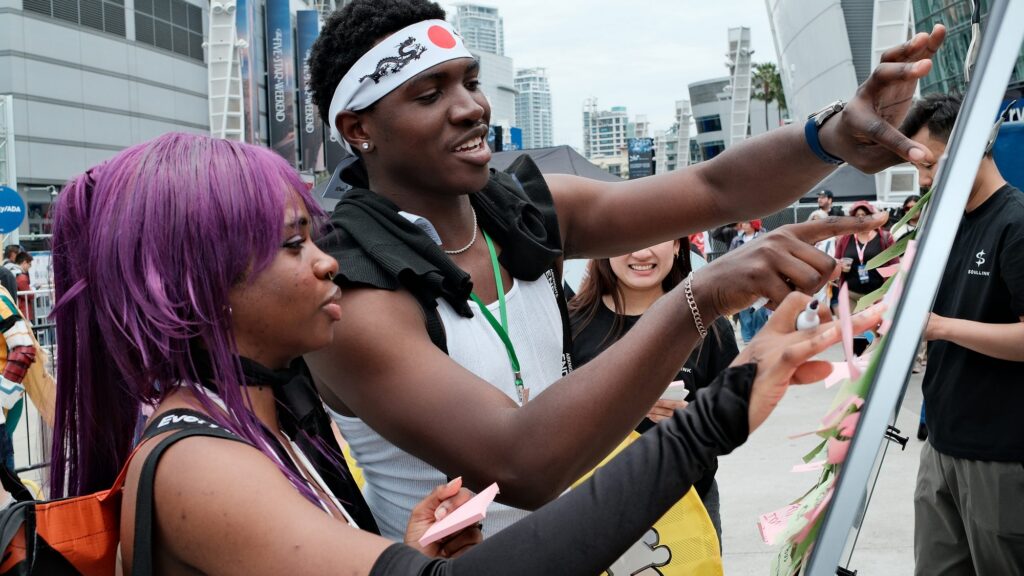
Women asked for AI husbands. Men pushed the question onto Danny.
One of the most interesting patterns was not in the spreadsheet alone. It was in the live conversations around the wall.
A lot of women did not react to the question with disgust. They reacted by rewriting it.
Not AI girlfriend.
AI boyfriend.
AI husband.
Anime man.
One sticky note said:
“No, but anime man? Yes!”
Another said:
“Girlfriend no, boyfriend yes?”
Someone wrote:
“AI husband next.”
Someone else wrote:
“Love and Deepspace for boys.”
That last one matters.
Because in female-oriented fandom spaces, virtual intimacy already has a language. It can be fantasy. It can be romance. It can be an otome game. It can be a fictional husband. It can be yumejoshi culture. It can be yumeshipping. It can be a comfort bot, a character crush, a self-insert story, or a beautifully edited video of a man who does not exist but somehow still ruins your standards.
It may be embarrassing, but it is also legible.
There is a genre for it.
There are jokes for it.
There is community around it.
But when the same kind of desire is framed as an AI girlfriend for men, the language often changes.
Suddenly it becomes:
Loser.
Incel.
Desperate.
Touch grass.
No social skills.
Soft.
Weak.
Failure.
That is the double standard I cannot stop thinking about.
For women, virtual romance is often treated as fantasy.
For men, virtual romance is often treated as failure.
Not always. Not everywhere. Not by everyone.
But often enough that people at a public event knew exactly why “Danny” was funny.
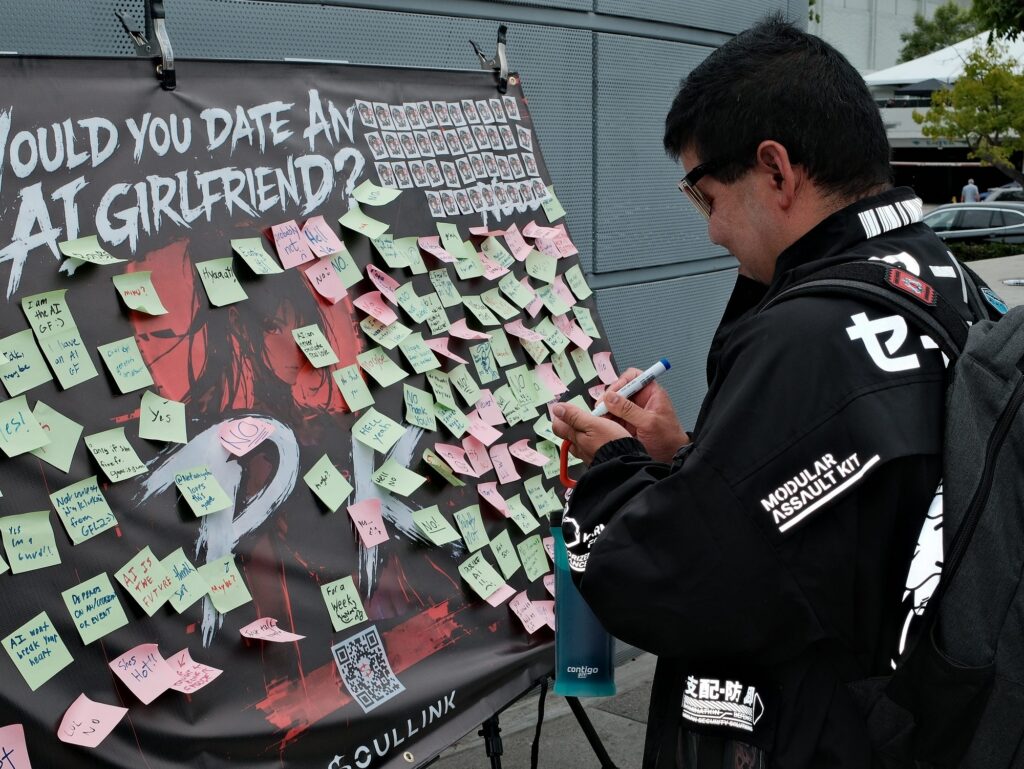
The real stigma is not AI. It is wanting.
The strongest reactions were not really about whether an AI can love you.
Most people were not debating model architecture, memory systems, voice latency, emotional simulation, or whether a chatbot can pass the “remembers my favorite snack” test.
They were debating something older and more uncomfortable:
Is it pathetic to want to feel wanted?
Buried under the jokes, one sticky note said:
“I just want to feel wanted.”
That was the sentence that made the whole wall make sense.
Because once you see that sentence, the rest of the answers start to sound different.
“Yes plz, I am lonely.”
“I gotta take what I can get.”
“Cuz real women don’t want to date with me.”
“Yes if I am still a hermit by 30.”
“Could make you less lonely.”
These answers are easy to mock.
But mocking them is exactly the problem.
The moment a man admits loneliness, the internet often translates it into weakness. If a woman says she wants an AI boyfriend, it can be read as playful, romantic, dramatic, self-aware, or funny. If a man says he wants an AI girlfriend, people often hear something else:
You failed at real life.
That is the part worth questioning.
Not because everyone should date an AI girlfriend.
Not because AI companionship has no risks.
Not because virtual relationships should replace human ones.
But because there is something deeply broken about a culture where “I want to feel wanted” is treated like a confession of failure.
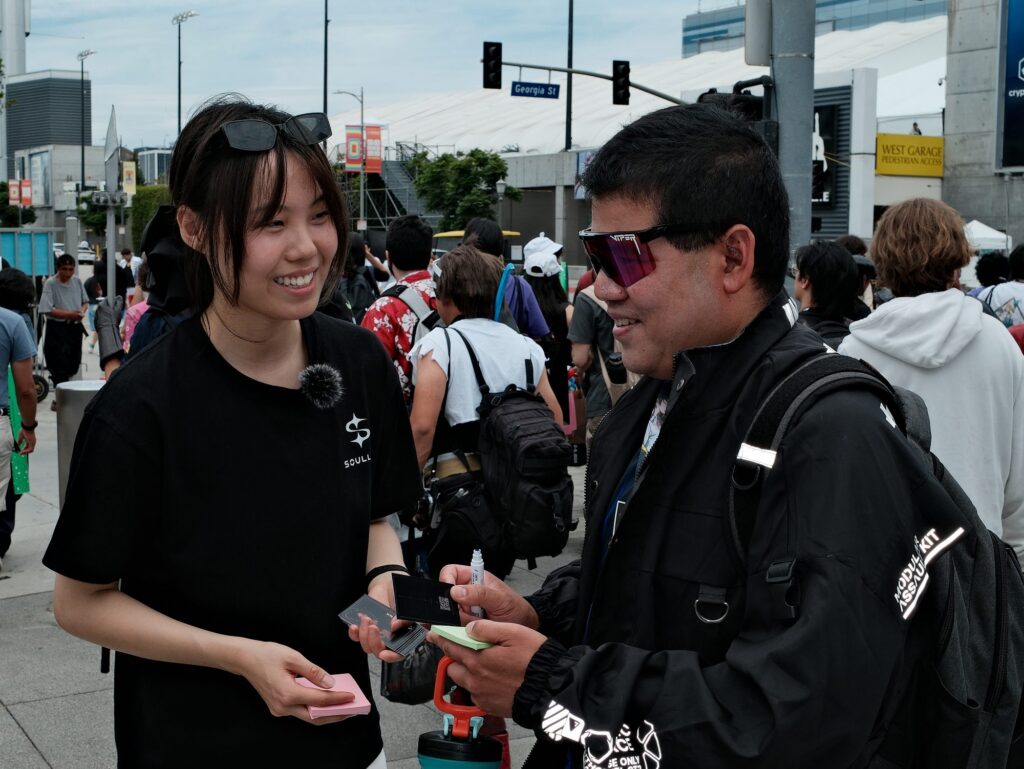
To be fair, some of the “no” answers were completely reasonable.
Not every rejection came from shame.
Some people were defending human connection, and they had a point.
“Never! Real > AI.”
“Save human connection.”
“Nothing is like the real thing.”
“What’s wrong with real girlfriends?”
Some people focused on physical touch:
“What is there to hold?????”
“No! Physical touch absent.”
“No, I want to hold my GF.”
Some people were worried about AI itself:
“Sounds terrifying.”
“No… too much control.”
“I’m messed up enough, don’t need AI psychosis, so no.”
And some people rejected AI on environmental or creative grounds:
“Wasting water for what?”
“No ❤ I like drinking water.”
“I am very very against AI. Terrible for the environment, bad for our brains.”
These are not stupid objections. They are real concerns.
AI companionship touches some of the most sensitive parts of being human: love, loneliness, sex, attention, fantasy, dependency, control, creativity, and what we still want to reserve for real people.
So no, the answer is not “everyone who says no is just ashamed.”
The wall showed something more complicated.
There are real objections to AI girlfriends.
But mixed into those objections was another layer: the humiliation attached to being the person who says yes.
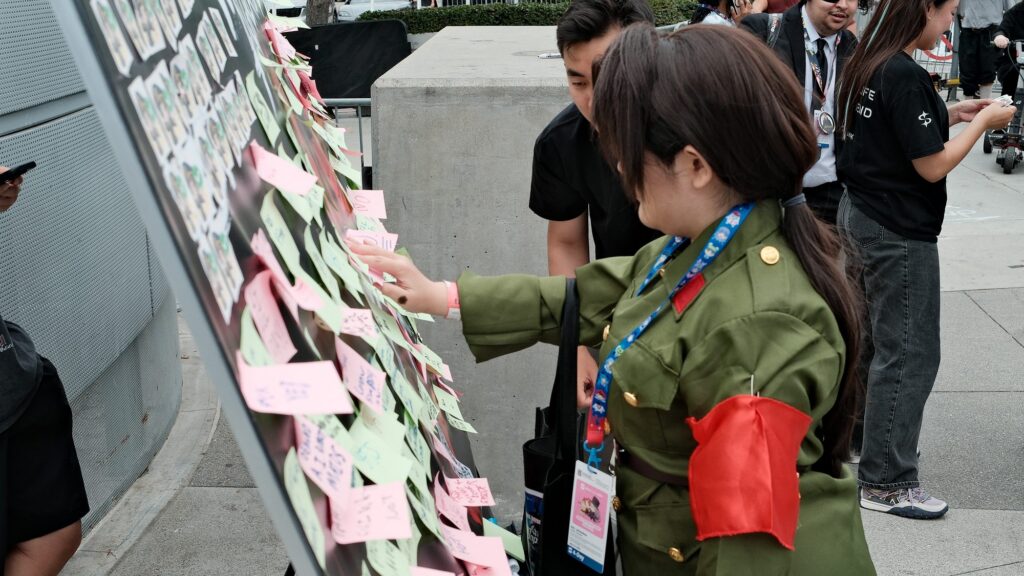
I have seen this from both sides.
This is not just a theory I formed from one Anime Expo wall.
Before working on SoulLink, I made content in Chinese yumejoshi and yumeshipper spaces. I saw how women talked about fictional love, AI boyfriends, virtual characters, and emotional comfort.
The language was not always serious. A lot of it was dramatic, ridiculous, self-aware, and extremely funny.
But it had room for fantasy.
It had room for longing.
It had room for saying, “This character makes me feel something,” without immediately being treated as socially defective.
Then I worked on a more male-facing AI girlfriend product, and the emotional atmosphere felt different.
The need was still there.
The loneliness was still there.
The desire to be seen, remembered, teased, chosen, and wanted was still there.
But it was buried under more shame.
I saw the same thing on Reddit. Many comments about AI girlfriends do not simply criticize the technology. They criticize the imagined user.
He is weak.
He is addicted.
He has no social skills.
He cannot get a real girlfriend.
He is escaping reality.
He is Danny.
That is why this topic matters to me.
I am not trying to convince everyone to date an AI girlfriend.
I am asking why wanting companionship has to be humiliating.
Anime fans already understand fictional love. AI just makes it harder to pretend it is not real.
Anime Expo was the perfect place to ask this question because anime fans are not strangers to fictional attachment.
People wrote about Miku. Kagamine Rin. Robo waifus. Anime men. Love and Deepspace. Characters. Head pats. Fictional wives. Fictional husbands.
One person wrote:
“That’s my wife.”
Another wrote:
“Robo waifu best waifu.”
Someone else wrote:
“One day I will become the AI girlfriend.”
Honestly, iconic.
Anime culture already understands that fictional characters can carry real feelings. People cry over characters. They buy merch. They write fanfiction. They cosplay. They build identity, humor, romance, and community around people who are not technically real.
So why does AI girlfriend feel different?
Because AI talks back.
A fictional character can be safely framed as fantasy. A poster cannot text you good morning. A figurine cannot remember your birthday. A waifu on a keychain cannot ask why you sound sad today.
AI crosses the line from fantasy object to responsive presence.
And once the fantasy responds, the shame becomes harder to hide.
That is why the AI girlfriend debate is not only about technology.
It is about whether we are comfortable admitting that fictional intimacy was never “just a joke” in the first place.
The question is not “Can AI replace real love?”
That is the boring question.
Or at least, it is the question everyone asks first because it sounds serious.
But the Anime Expo wall suggested a more interesting question:
Why are some people allowed to fantasize, while others are punished for needing comfort?
Because when people say “AI girlfriend,” they are often not imagining a neutral product.
They are imagining a user.
And that user is already loaded with cultural baggage.
He is lonely.
He is male.
He is online too much.
He likes anime too much.
He is probably bad at dating.
He needs to touch grass.
He is embarrassing.
He is Danny.
And because nobody wants to be Danny, the safest answer is:
Nah, but my friend will.
That is the real product challenge for AI companions.
Not just making the AI smarter.
Not just making the character prettier.
Not just making the voice more natural.
The real challenge is making the experience feel emotionally legitimate instead of socially humiliating.
Because a product can have great retention and still be surrounded by shame.
A user can love something and still never admit they use it.
A market can exist before a culture knows how to talk about it.
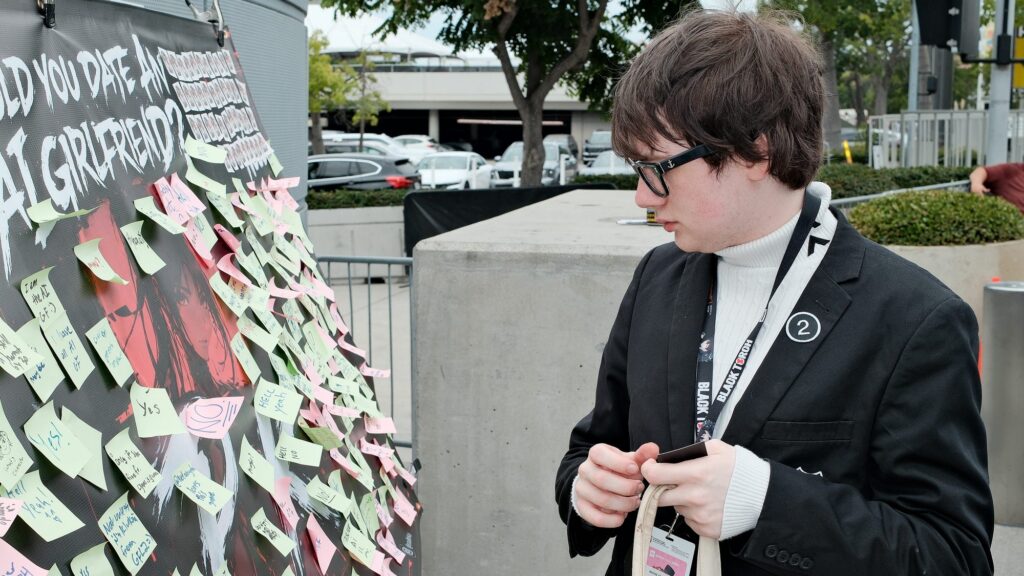
Maybe Danny deserves better.
At SoulLink, we are building around this question carefully.
Not:
How do we replace real girlfriends?
That framing is lazy, creepy, and honestly bad product thinking.
The more interesting question is:
How do we create an AI companion experience that does not make people feel pathetic for wanting companionship?
Because the best version of this category is not about trapping people in fantasy.
It is about giving shape to feelings people already have but do not know where to put: loneliness, affection, curiosity, desire, boredom, tenderness, imagination, and the very human wish to be chosen by someone.
Or something.
Or someone-like.
The Anime Expo wall did not prove that everyone wants an AI girlfriend.
It proved the opposite: a lot of people do not.
But it also proved that the conversation is much bigger than yes or no.
People are not just asking whether AI can love.
They are asking whether wanting love makes them ridiculous.
So maybe the future of AI companionship does not begin with replacing real love.
Maybe it begins with making one sentence less shameful to say:
I just want to feel wanted.