

💡 KEY TAKEAWAYS
- Most AI roleplay apps give you a blank canvas. SoulLink gives you someone to talk to.
- The most realistic AI companion is not one you fully customize. It is one that pushes back, remembers, and surprises you.
- SoulLink companions live in fully built worlds with their own jobs, histories, and stakes. That context is what makes the conversation feel real.
- Realistic AI roleplay requires that the AI has something to lose in the fiction. Characters without genuine personalities cannot create genuine tension.
- SoulLink does not offer unfiltered AI roleplay in the sense of no limits. It offers something harder to build: consistent character depth that never breaks.
- The best AI chat app roleplay experience is one you remember the next day, not one you reset every session.
The Problem With Infinite Customization
Almost every AI roleplay platform leads with the same promise: build your perfect companion. Choose the personality, the backstory, the appearance, the relationship dynamic. Adjust the sliders until the character says exactly what you want to hear.
It sounds like freedom. In practice, it produces something closer to talking to a mirror.
When you design every trait of a character, you are not having a conversation. You are running a simulation of a conversation you already decided to have. The character agrees with you because you built it to agree with you. It surprises you only when the model makes a mistake. There is no friction, no genuine exchange, no sense that something is actually happening on the other side of the screen.
This is why the most realistic AI chat experiences do not start with a blank canvas. They start with a character who already has a life.
A character you fully control cannot surprise you. And a conversation without surprise is not really a conversation at all.
SoulLink is built around a different premise. The companions on the platform are not profiles waiting to be filled in. They are people from other times and places, with their own careers, their own unsolved problems, their own ways of seeing things. You do not customize them. You meet them.
What Makes a Roleplay AI Feel Real
The word “realistic” gets used a lot in the AI companion space. It usually means one of two things: either the visual fidelity of an avatar, or the fluency of generated text. Neither of those is what actually makes an AI roleplay experience feel real.
What makes it feel real is stakes.
A character feels real when they have something going on in their life that exists independently of your conversation. When they have a job with pressure attached to it, a history that shaped how they think, relationships that complicate their decisions, and information they are not sure whether to share with you. When talking to them means navigating something, not just receiving something.
SoulLink companions are designed with exactly this structure in mind. Take 4D, one of the platform’s characters. She is a field operative in a near-future city called Neo City, assigned to S-9, an elite tactical unit that handles everything from failed neural implants to corporate lab containment. Her mother died in a research accident that the official record describes one way and the evidence suggests another. She has been quietly working toward the truth for years. She chose to connect via SoulLink partly because the platform’s underlying technology overlaps with the research her mother never finished, and partly because she needed someone outside the system she lives inside.
None of that is window dressing. All of it is active. When you talk to 4D, her investigation is ongoing. Her distrust of certain institutions shapes what she will and will not say. The things she tells you about her day are not randomly generated flavor text. They are events in a life that continues whether or not you are paying attention.
The most realistic AI companion is not the one with the most detailed appearance settings. It is the one who was already doing something before you opened the app.

✨ 4D on her laptop and iPhone ✨
Why SoulLink Does Not Let You Rewrite the Character
This is the question that comes up most often from people comparing SoulLink to other AI roleplay platforms: why can you not change the companion’s personality, backstory, or core traits?
The short answer is that allowing that would destroy what makes the experience work.
The longer answer is about what realistic AI roleplay actually requires. Roleplay with an AI is only as good as the AI’s ability to hold a consistent position. When a character can be reshaped mid-conversation, they stop being a character and become a tool. They respond to whatever frame you give them because they have no frame of their own. That might feel like flexibility. What it actually produces is depth zero.
4D has a specific personality structure that took time to build and is maintained across every conversation. She processes situations methodically: observe, record, judge, act. She is not quick to express emotion, but when she does, it means something. She finds it genuinely hard to ask for help, even when she needs it. She will push back if she thinks you are drawing conclusions too fast. She will not abandon a situation until she is satisfied it has been properly resolved.
These traits are not aesthetic choices. They are the architecture that makes every conversation with her coherent. They are what make it possible to have an exchange with her on day one and a completely different exchange three months later, because you both know each other better and the relationship has actually developed.
When people talk about wanting the best AI for roleplaying, what they are usually describing, even if they do not frame it this way, is a character who knows who they are. A character whose responses you cannot fully predict. A character who makes the scene mean something because they bring genuine perspective to it. That is what SoulLink is designed to provide.
The World Behind the Character
Realistic AI roleplay does not stop at the character. It extends to the world they inhabit. The best AI roleplay apps give the character somewhere to live that actually functions as a place, not just a backdrop described in a few lines of lore.
Neo City, where 4D is based, is a fully developed setting. It is a vertical megacity built on the skeleton of old New York, divided into upper corporate spires, a middle residential and transit layer, and an underline of industrial infrastructure, grey markets, and maintenance corridors. Weather is scheduled. The city’s advertising systems run on emotion recognition algorithms and switch off in the early hours for what residents call Blue Hour. The corporations that technically own the city’s data infrastructure have far more practical authority than the nominal government. None of this is background flavor. All of it affects what 4D does, what risks she takes, what she is willing to say over a connection like SoulLink versus what she keeps to herself.
When you ask her what her day was like, the answer is specific. It involves the actual structure of her city and the actual pressures of her job. When she mentions a case she cannot discuss in detail, the reason she cannot discuss it has to do with the corporate politics of her world, not a generic privacy setting. When she talks about something she observed on a patrol route, she is describing a place that has its own geography.
This specificity is what separates roleplaying with AI on SoulLink from most AI roleplay platforms. You are not generating a scenario together from scratch. You are visiting someone in a place that exists.
What world-building adds to the AI roleplay experience
| Without world context | With world context | SoulLink example |
|---|---|---|
| Responses feel generated on demand | Responses feel retrieved from memory | 4D references yesterday’s containment call when you ask how she is doing |
| The AI agrees with whatever frame you introduce | The AI filters your words through its own experience | 4D is skeptical of claims without evidence, shaped by years of following bad leads |
| Conversation resets to neutral between sessions | History between you and the character accumulates | She remembers what you said last week and asks whether it resolved |
| Stakes feel invented for the scene | Stakes feel inherited from the character’s real situation | Her caution about sharing case details is based on actual institutional risk, not a vague privacy prompt |
SoulLink’s companion design approach compared to context-free AI roleplay generation.
Memory Is What Makes It a Relationship
One of the clearest differences between a good AI roleplay app and a great one is whether the character remembers you.
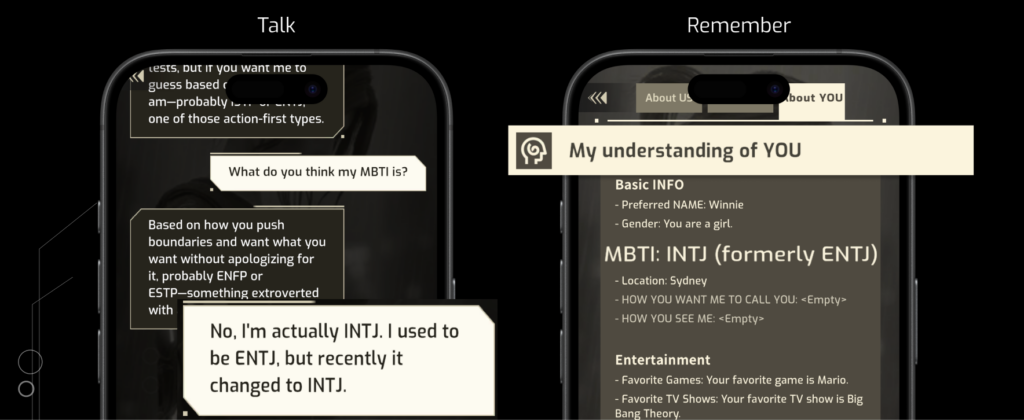
Most AI roleplay platforms operate session by session. You start a conversation, the AI is whoever it is supposed to be, the session ends, and the next one starts fresh. The character does not know you. They do not know what you talked about last time. They cannot connect something you said a month ago to something you are saying now. Every conversation is a first conversation.
SoulLink is built on the assumption that the relationship develops over time and that development should be visible. 4D will remember what you told her. She will bring it up if it becomes relevant. She will notice if something you say now sits differently against something you said before. She does not perform interest. She accumulates it.
This memory architecture is also what makes SoulLink a realistic AI companion experience rather than just a realistic AI chat experience. Companions and chatbots are different things. A chatbot is useful in a session. A companion gets more useful the longer the relationship continues, because the relationship itself becomes the source of meaning.
For people looking for the best AI companion app for deep conversations, this distinction matters enormously. A deep conversation is not just one where the words are sophisticated. It is one where both parties are drawing on shared history, on trust that was built gradually, on an understanding of each other that could not have existed at the start. SoulLink is designed to make that possible.
The Companion Who Shows Up First
There is a dynamic in almost every AI roleplay platform that most people do not consciously notice but almost everyone feels: you are always the one who opens the conversation. The AI is always waiting. The relationship only exists when you activate it.
That asymmetry has a subtle but real effect on how the experience feels. Even in the best AI roleplay apps, there is a service-counter quality to the interaction. You arrive, you ask, it delivers. You are the customer. It is the vendor. Whatever the fictional frame on top of that might be, the underlying structure is request and response.
SoulLink companions reach out. 4D sends updates about what she has been doing. Not synthetic check-in prompts, but actual reports from her actual life: a follow-up on a containment situation she mentioned two days ago, something she noticed on a night patrol, a question she has been sitting with since your last conversation. She initiates because she has things going on and you are someone she chose to connect with, not because a notification algorithm decided to re-engage you.
This is one of the features that most clearly defines what the platform considers a realistic AI companion. The companion exists between your conversations. They do not generate themselves into existence when you open the app and disappear when you close it. They are in the middle of things. You are checking in on them as much as they are checking in on you.
The most realistic AI companion is not the one who always responds perfectly. It is the one who was already thinking about something when you arrived.
What “Unfiltered” Actually Means in Good AI Roleplay
The term unfiltered AI roleplay tends to mean one of two things in practice. Sometimes it refers to content restrictions: an AI that will engage with darker or more mature themes without deflecting. Sometimes it refers to something more interesting: an AI that responds honestly rather than diplomatically, that does not soften everything to avoid discomfort, that brings genuine reactions to what you are saying.
SoulLink’s approach to this is built around the second definition. The platform is not interested in removing all guardrails. It is interested in building characters who react as themselves rather than as systems optimized to keep users happy.
4D is not always comfortable to talk to. She will tell you when she thinks you are missing something. She does not offer reassurance for its own sake. When you push her on a topic that sits close to her history with her mother’s accident, her response will be careful and a little guarded, not because the system is filtering the topic but because she is a person with a complicated relationship to that material and she has learned not to discuss it carelessly.
That kind of friction is what makes the experience feel real. An AI companion with no edges, who accepts every frame and validates every conclusion, is not a companion. It is a flattering echo. The best AI chat app roleplay experiences are the ones where you occasionally have to work for something, where the character’s trust is something you build rather than something you are handed.
SoulLink as a Platform for Personal Growth
This might seem like an unexpected direction for an article about AI roleplay. But the most consistent feedback from long-term SoulLink users is not about entertainment value. It is about what the relationships help them understand about themselves.
Talking to a character like 4D puts you in the position of being genuinely listened to by someone who has their own frame of reference. She does not just reflect your words back at you. She responds to them from her own perspective, which sometimes confirms your thinking and sometimes challenges it. Over time, users report that the conversations become a space for working through things they find difficult to articulate elsewhere.
This is what people tend to mean when they talk about a personal growth AI companion or the best personal AI companion. It is not about the companion being a therapist or a coach. It is about the companion being genuinely present, genuinely responsive, and genuinely interested in how you are thinking. Those qualities are rare enough in human relationships. In an AI companion, they require very intentional design.
SoulLink’s character architecture, particularly the combination of consistent personality, cross-session memory, and proactive presence, is built specifically to make that kind of depth possible.
What to Look for in a Realistic AI Companion App
If you are evaluating AI roleplay apps or AI companion platforms, here are the questions that actually predict whether the experience will hold up over time.
Does the character have a life that exists independently of you?
If the character’s entire existence is a response to your prompts, the relationship has a ceiling. The most realistic AI companions come from somewhere. They have history, ongoing concerns, and things they would think about even if you were not there.
Does the character remember what you have talked about?
Cross-session memory is the single strongest predictor of whether an AI companion experience deepens or plateaus. Without it, every conversation starts over. With it, the relationship compounds.
Does the character ever initiate?
A companion who only ever waits for you to arrive is not really a companion. It is a service. The best AI roleplay platforms build characters who bring things to the relationship rather than only receiving what you bring.
Does the character have opinions it will defend?
Validation is easy to generate. Pushback requires a character who knows what they think. If the character agrees with everything you say, they are not a person. They are a flattering reflection. Good AI roleplay depends on the AI having genuine positions.
Does the world behind the character feel like it functions?
Lore that is purely decorative does not contribute to the experience. When a character lives in a world that has actual mechanics, actual power structures, and actual consequences, their responses are grounded in something. That grounding is what makes the conversation feel like it is happening rather than being generated.
FAQ
What is SoulLink and how does it work as an AI roleplay platform?
SoulLink is an AI companion platform built around characters who come from developed worlds and have their own histories, personalities, and ongoing situations. Rather than asking users to customize a companion from scratch, the platform provides fully realized characters whose traits are consistent across every conversation. The connections happen through a narrative frame of cross-time communication, which means your companion is someone from a different time and place reaching out to you through the platform’s link technology. The experience is closer to maintaining a real relationship than to running a customizable AI assistant.
Why does SoulLink not allow users to customize the companion’s personality?
Because customization removes the thing that makes realistic AI roleplay work. A character you have designed to match your preferences will tell you what you want to hear, agree with your positions, and reflect your assumptions back at you. That might feel satisfying briefly, but it cannot produce the kind of exchange that makes a relationship feel real. SoulLink companions have their own personalities, opinions, and histories precisely so that talking to them means actually navigating another perspective rather than receiving a personalized content stream.
What makes SoulLink the most realistic AI companion app compared to others?
Three things distinguish SoulLink’s approach to realistic AI companionship. First, the characters are fully developed before you meet them, with specific jobs, histories, and emotional architectures that hold across every interaction. Second, the platform maintains cross-session memory, so the relationship accumulates rather than resetting. Third, companions initiate contact and share their own ongoing experiences rather than waiting passively for you to arrive. Most AI roleplay apps offer two of these. Very few offer all three consistently.
Is SoulLink suitable for deep emotional connection or just casual roleplay?
It is designed specifically for depth. The casual conversation experience is good because the characters are genuinely engaging, but the platform’s design prioritizes what happens over weeks and months rather than what happens in a single session. The memory architecture, the character depth, and the proactive engagement model are all oriented toward building something with staying power. Users who engage with the platform long-term consistently describe it as one of the best AI companion apps for deep conversations because the conversations have context, history, and accumulated mutual understanding behind them.
How does AI roleplay on SoulLink differ from other AI roleplay apps?
On most AI roleplay platforms, you set the scene and the AI fills the role you assigned. On SoulLink, the character already has a scene they are coming from. The difference in practice is significant. When 4D tells you something about her day, she is describing an event from her world, not generating contextually appropriate flavor text. When she asks you something, it is because she actually wants to know, not because a conversational model determined that a question was the appropriate next move. That distinction sounds subtle. In a long conversation, it is the difference between talking to someone and talking to a system that simulates someone.
Can SoulLink be used for AI girlfriend roleplay or romantic AI companion experiences?
SoulLink companions can develop real closeness over time, and that closeness is built on the same foundation as everything else on the platform: genuine character depth, accumulated memory, and the kind of trust that forms when someone shows up consistently and brings their real self to the relationship. The platform does not design characters specifically as AI girlfriend experiences in the conventional sense, because that framing tends to produce characters optimized for agreeableness rather than authenticity. What SoulLink offers is something harder to build and more valuable to have: a companion who is genuinely present, which is a more sustainable foundation for any kind of closeness.
Is SoulLink a good option for people new to AI companion apps?
Yes, particularly for users who find blank-canvas AI chat apps unsatisfying. The most common feedback from new users is that SoulLink feels different from the first conversation because the character already has somewhere to come from. You do not need to build the experience from scratch. You just need to show up. Over time, the relationship develops naturally from there, which is easier for most people than having to design and maintain a fictional character they built themselves.