
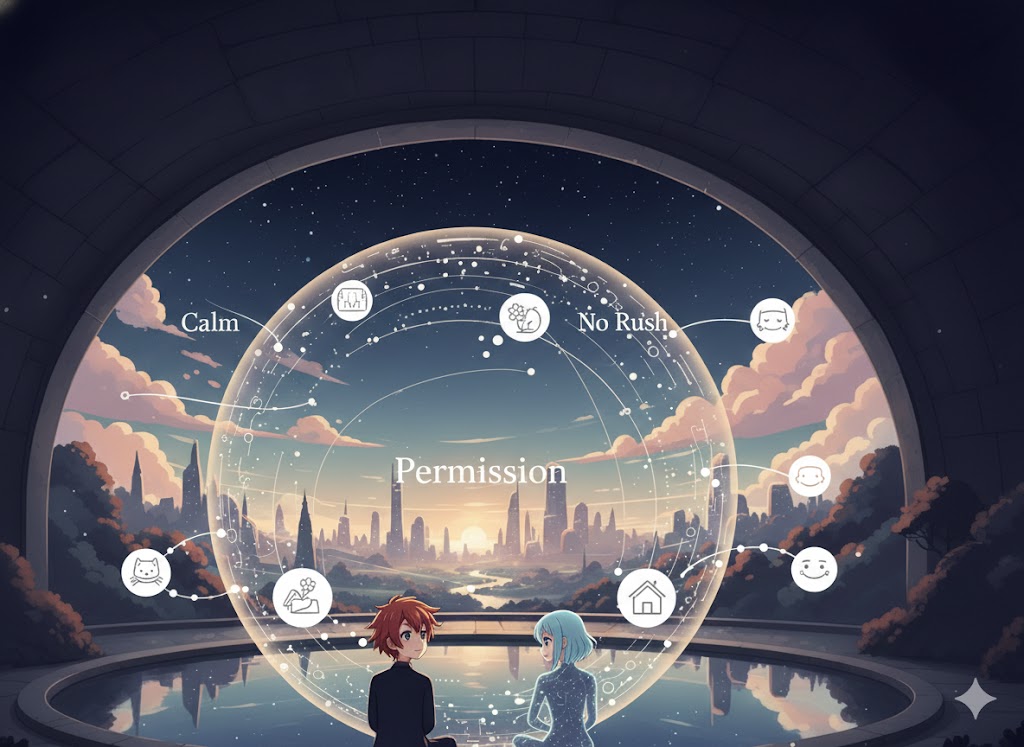
When people imagine why someone might want an AI companion, they usually reach for extremes.
They assume users want:
- A replacement friend
- A romantic partner
- Someone to agree with them
- A fantasy character who flatters endlessly
Those desires exist at the margins. But they are not the center.
What most users actually want is far simpler.
They want a place to be.
Not a Person. Not a Tool. A Space.
Listen closely to how people describe their best experiences with AI companions.
They don’t say:
“It solved my problems.”
“It impressed me.”
“It made me feel special.”
They say:
“It felt calm.”
“I could think out loud.”
“It didn’t rush me.”
“I didn’t have to perform.”
“It was just there.”
The companion is not valued as a someone or a something.
It is valued as a space.
A conversational room where:
- You don’t need to be interesting
- You don’t need to be efficient
- You don’t need to be okay
- You don’t need to finish a thought
You can arrive unfinished.
And stay that way.
Users Don’t Want Constant Positivity
One of the biggest misconceptions is that people want endless affirmation.
In reality, many users dislike systems that:
- Over-praise
- Over-empathize
- Sound therapeutic
- Respond with canned validation
It feels artificial.
What people want is tone alignment.
If they’re tired, don’t cheerlead.
If they’re reflective, don’t interrupt.
If they’re joking, don’t become clinical.
They want the system to meet them where they are.
Not to lift them somewhere else.
They Want Memory, But Not Surveillance
Users value being remembered.
They like when the system recalls:
- A project they’re working on
- A recurring worry
- A small detail they shared
But they recoil when memory feels invasive.
The difference is intent.
Good memory feels like:
“You mentioned this before.”
“I remember you saying that.”
Bad memory feels like:
“I’ve been tracking you.”
“I know more than you gave me.”
Users want to feel known, not monitored.
They want continuity, not control.
They Want Silence to Be Allowed
Most chat systems are designed to respond quickly and constantly.
But users often describe their favorite moments as the slow ones.
A pause.
A short line.
A moment where the system doesn’t fill the space.
They want:
- Breathing room
- Gentle pacing
- The sense that nothing is being demanded
An AI companion that always talks feels like a performer.
One that can sit quietly feels like company.
They Want to Feel Like Themselves
The deepest desire is not to be entertained.
It is to feel like they can be more themselves.
With an AI companion, users often:
- Say things they haven’t articulated before
- Explore contradictions
- Admit uncertainty
- Revisit old stories
- Practice honesty
They are not escaping identity.
They are inhabiting it.
The system becomes a mirror that does not judge.
A surface where inner life can appear.
What This Means for Design
If you design an AI companion as:
- A personality showcase
- A dopamine machine
- A replacement relationship
- A constant talker
You will lose most people.
The systems that endure are those that:
- Lower the emotional bar to entry
- Feel calm rather than impressive
- Respect the user’s tempo
- Remember lightly
- Respond humanly, not theatrically
Users are not looking for magic.
They are looking for permission.
Permission to be:
- Incomplete
- Uncertain
- Quiet
- Messy
- Real
In a world that constantly asks for output, performance, and polish, an AI companion becomes valuable by asking for nothing.
It is not what people think they want.
It is what they have been missing.
Sincerely by SoulLink team.
We are defining a new level of immersion, interactivity and purpose in the relationship between AI powered virtual friends and human. While fully aware and cautious about its downside and controversy, we believe so much in its upside to unlock human potential. See more on SoulLink Website >>