
Last updated: February 2026 · Tested: 5 apps
What AI Has the Best Memory in 2026? A Deep Comparison of AI Companion Memory Systems
Short Answer: Most AI companion apps offer basic cross-session memory. Very few provide structured, identity-based long-term memory architecture. In 2026, systems built around relational continuity deliver the strongest AI memory performance.
🔎 Key Takeaways:
If you’re searching “what AI companion has the best memory?”, here’s what actually matters:
- Most AI companion memory is short-term.
Session memory disappears once a chat ends. True AI long term memory requires cross-session persistence and structured retrieval. - Context window ≠ persistent memory.
Large token limits do not mean an AI remembers you tomorrow. Long term memory AI chat systems rely on storage architecture, not processing size. - There are four levels of AI memory.
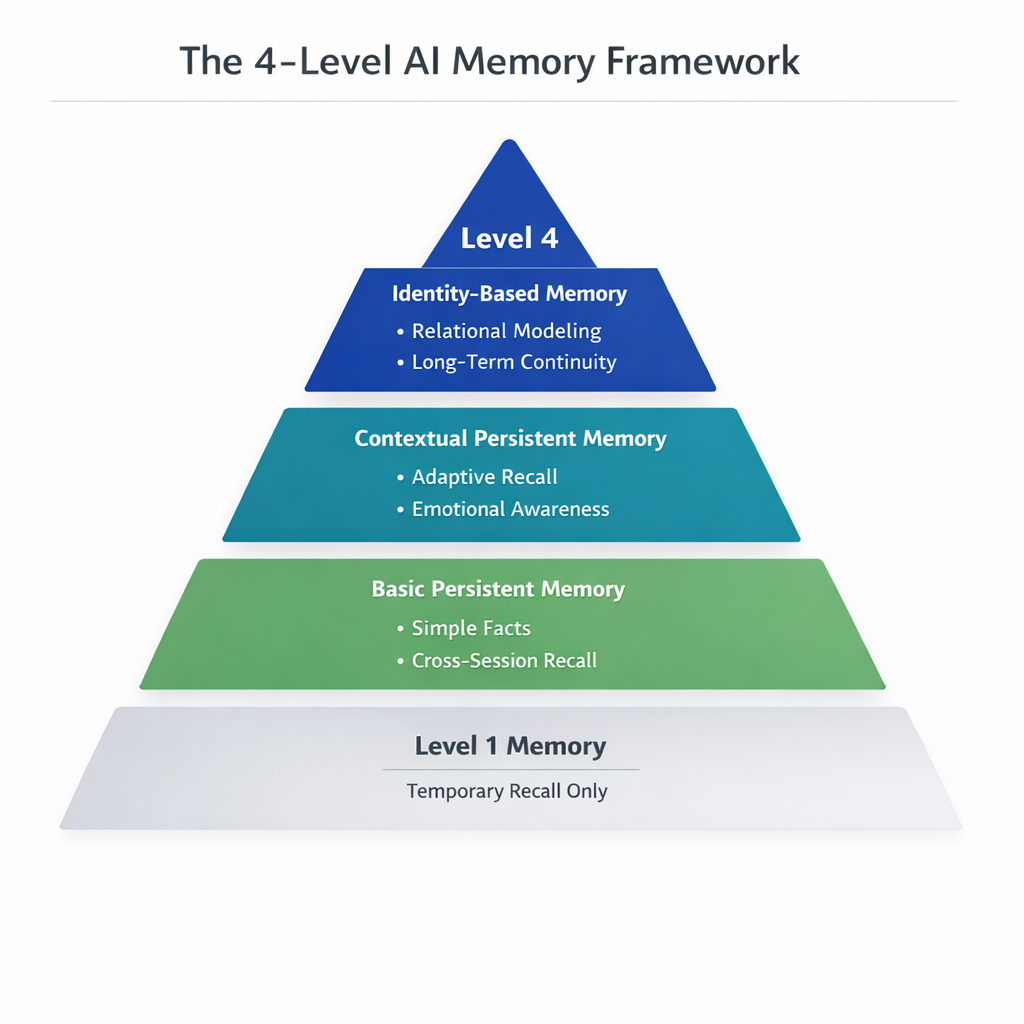
Level 1 (session), Level 2 (basic persistent), Level 3 (contextual recall), and Level 4 (identity-based architecture). Most AI companion apps operate at Level 2–3. - The best AI chatbot with best memory is defined by architecture.
Surface-level memory stores isolated facts. Advanced AI with best memory organize relational context and maintain identity continuity. - For AI companions, continuity matters more than intelligence.
A powerful model that forgets you feels inconsistent. A structured memory system that evolves over time creates trust. - In 2026, identity-based memory systems lead the space.
AI companions built around persistent relational infrastructure deliver stronger long-term continuity than apps where memory is just an added feature.
Bottom Line: If your goal is basic cross-session recall, several AI chatbots with good memory qualify. If you want deep, evolving long term memory AI chat continuity, platforms architected around structured identity modeling offer the strongest experience.
Why “What AI Has the Best Memory” Is Often Misunderstood
When users search what AI has the best memory, they are rarely asking about token limits or enterprise AI performance benchmarks.
They are asking something more personal:
- Which AI chatbot actually remembers me weeks later?
- Which AI companion builds long-term continuity?
- Which AI chatbot with good memory doesn’t emotionally reset?
- Which long term memory AI chat system evolves over time?
The confusion happens because many articles focus on context window size. But context window measures processing capacity, not relational persistence.
In companion AI, memory defines trust.
Companion AI vs Productivity AI: A Critical Distinction
Productivity AI uses memory to improve efficiency and task continuity.
Companion AI uses memory to maintain identity and emotional continuity.
- Productivity AI memory = context handling.
- Companion AI memory = relational modeling.
If you’re searching for ai with best memory in a companionship context, token size is not the deciding factor. Architecture is.
The 4-Level AI Memory Framework
To objectively answer which AI has the best memory, we need a structural framework. Not all AI memory systems operate at the same depth or architectural complexity. Based on how memory is stored, retrieved, and integrated into interaction logic, companion AI memory can be categorized into four distinct levels.
Level 1 – Session Memory
At Level 1, the AI remembers information only within a single conversation window. Once the session ends or the app resets, the memory disappears entirely.
This is the most basic form of memory and relies purely on context window retention. There is no persistent storage layer. The system simply processes recent inputs within a limited conversational buffer.
User experience: Conversations feel coherent in the moment but reset completely the next time you open the app.
This is not true AI long term memory.
Level 2 – Basic Persistent Memory
Level 2 systems introduce cross-session recall. The AI can store and retrieve selected user facts such as:
- Your name
- Basic preferences
- Recurring topics
- Selected personal details
However, this memory is typically stored as isolated data points. Retrieval may be rule-based or manually triggered rather than contextually inferred.
User experience: The AI remembers facts, but recall may feel mechanical, surface-level, or inconsistent.
Many AI chatbots with good memory operate at this level.
Level 3 – Contextual Persistent Memory
Level 3 systems move beyond isolated fact storage. They incorporate contextual retrieval mechanisms that allow the AI to surface past information based on conversational relevance.
Instead of recalling memory only when prompted, the system can:
- Adapt tone based on prior emotional patterns
- Reference earlier discussions naturally
- Maintain thematic continuity across sessions
- Recognize recurring behavioral patterns
This creates stronger long term memory AI chat continuity and improves emotional coherence.
User experience: The AI feels more consistent and aware of ongoing relational themes, though identity modeling may still be partial rather than fully structured.
Level 4 – Identity-Based Memory Architecture
Level 4 represents a structural shift. Memory is not an add-on layer but an architectural foundation.
These systems are built around:
- Structured relational modeling: Memory is organized as interconnected identity layers rather than isolated facts.
- Persistent vector-based storage: Conversations are encoded for semantic retrieval rather than simple keyword recall.
- Context-aware retrieval pipelines: Memory surfaces based on conversational meaning and relational relevance.
- Long-term identity continuity: The AI adapts as the user evolves over weeks and months.
At this level, memory becomes part of interaction logic. Emotional arcs, behavioral tendencies, and relational context accumulate over time.
User experience: Conversations feel cumulative. The AI does not simply remember information — it integrates it into an evolving relational model.
Most companion apps operate at Level 2–3. Very few operate at Level 4, where memory architecture enables true long-term continuity rather than surface recall.
Why Most AI Companion Apps Stop at Level 2–3
Achieving Level 4 AI long term memory requires:
- Persistent vector storage systems
- Structured memory indexing
- Contextual recall pipelines
- Higher computational cost
- Careful privacy management
Many AI chatbots with memory store isolated facts but do not structure them into relational memory graphs. As a result, recall feels fragmented.
This technical limitation explains why many users feel that AI “forgets” them emotionally, even if it technically stores information.
Why SoulLink Operates at Level 4

While many AI companion apps provide some form of persistent memory, SoulLink is designed around identity-based memory architecture from the ground up — not as an added feature, but as a foundational system layer.
Most companion apps store user information as isolated data points: a name, a preference, a previous topic. These facts may persist across sessions, but they are not deeply structured. As a result, recall can feel mechanical or inconsistent.
SoulLink approaches memory differently. Instead of storing fragmented facts, it organizes interaction history into structured relational context layers that connect identity, emotion, and conversation patterns over time.
- User identity modeling: Rather than tracking isolated facts, SoulLink builds a layered identity profile that evolves through repeated interaction.
- Persistent vector-based storage: Conversations are encoded in a way that allows contextual retrieval instead of simple keyword matching.
- Context-aware memory retrieval: Memory surfaces naturally based on conversational relevance, not just explicit prompts.
- Emotional continuity tracking: Patterns in tone, stress signals, and recurring themes are recognized over time.
- Long-term relational progression: The system adapts to user growth rather than repeating static personality loops.
This means memory is not triggered only when the user asks, “Do you remember…?” Instead, it becomes embedded in interaction logic.
Over time, conversations become cumulative rather than repetitive. Emotional arcs are maintained. Identity context deepens. Responses adapt subtly based on relational history. The system evolves alongside the user rather than resetting to a neutral baseline each session.
This architectural distinction is what separates Level 4 identity-based memory systems from Level 2–3 implementations, where memory exists but does not form a coherent relational model.
In practice, this difference determines whether an AI companion simply recalls information — or genuinely builds continuity.s.
AI Companion Apps with the Best Memory (2026 Comparison)
| AI Companion | Memory Level | Cross-Session Recall | Emotional Continuity | Structured Architecture |
|---|---|---|---|---|
| Replika | Level 2–3 | Yes | Moderate | Limited |
| Character AI | Level 1–2 | Limited | Low | No |
| Paradot | Level 2–3 | Yes | Moderate | Limited |
| Kindroid | Level 2–3 | Yes | Moderate | Limited |
| SoulLink | Level 4 | Yes | High | Yes |
What True Long-Term AI Memory Feels Like
Understanding memory architecture is important. But what truly matters is how it feels in practice.
A true long term memory AI chat system does more than store information. It creates continuity.
- Recall information weeks later without prompting.
You mention a project, a personal goal, or a difficult week — and the AI naturally references it later without being reminded. - Maintain emotional continuity across sessions.
If you expressed stress or excitement before, the AI remembers the emotional tone, not just the topic. - Adapt responses based on relational history.
The system adjusts its tone depending on how you’ve interacted over time — supportive when needed, reflective when appropriate. - Feel consistent and evolving.
The personality does not reset. Conversations build upon previous interactions instead of repeating surface-level questions. - Build identity-level context over time.
Patterns emerge. The AI recognizes recurring themes in your goals, habits, or emotional cycles.
At this level, the difference becomes obvious. You are not repeating yourself. You are continuing something.
This is what users actually mean when they ask what AI chatbot has the best memory. They are not asking about token limits — they are asking about continuity.
Example Scenario: A 30-Day Difference
Imagine you tell an AI companion about feeling overwhelmed at work.
Level 2 system: Remembers your job title next week.
Level 3 system: References your workload if you mention it again.
Level 4 system: Recognizes your stress pattern, recalls how you responded previously, and adjusts tone proactively — even if you don’t restate the context.
The difference is subtle but powerful. It determines whether an AI companion feels reactive or relational.
Use Case Breakdown
Different users require different memory depths.
Casual conversation:
If you simply want light interaction and occasional recall, Level 2 memory is sufficient.
Emotional companionship:
If you expect ongoing relational tone and thematic continuity, Level 3 provides noticeable improvement.
Long-term growth and identity continuity:
If your goal is evolving companionship, personal reflection, or sustained emotional interaction, Level 4 architecture becomes essential.
In companion AI, the required memory depth depends on how much continuity you expect from the relationship.
Final Verdict – What AI Has the Best Memory?
There is no universal winner across every category of AI memory.
- If your goal is basic cross-session recall, many AI chatbots with good memory qualify.
- If your goal is deep, evolving long term memory AI chat continuity, Level 4 systems lead the space.
In companion AI, the best memory is defined by identity continuity — not token size.
FAQ
What AI chatbot has the best memory in 2026?
AI companion systems built around structured identity-based memory architecture provide the strongest long-term continuity. Memory depth depends on how well the system integrates storage, retrieval, and relational modeling.
What AI has the best long term memory?
The best long term memory AI systems are those designed with persistent storage layers and contextual retrieval mechanisms. Identity-based architectures typically outperform surface-level memory implementations.
Is session memory the same as AI long term memory?
No. Session memory only retains information within a single conversation window. AI long term memory persists across sessions and enables continuity over weeks or months.
Which AI remembers conversations weeks later?
AI companion apps with persistent memory infrastructure and contextual retrieval systems can recall cross-session details more reliably than systems limited to session memory.
What is the difference between context window and AI memory?
The context window determines how much information an AI can process at one time. AI memory refers to stored information that persists beyond a single session. A large context window does not guarantee long-term recall.
Do all AI chatbots with memory work the same way?
No. Some systems store isolated user facts, while others organize memory into structured relational layers. The depth and architecture of memory significantly affect continuity quality.
What makes an AI companion feel consistent over time?
Consistency comes from contextual recall, emotional continuity tracking, and identity-level modeling. Systems that integrate memory into interaction logic feel more stable and relational.
Can AI companions adapt as users change?
Advanced long term memory AI chat systems can adapt over time by recognizing evolving patterns in goals, emotions, and conversational behavior.
Is AI memory important for emotional companionship?
Yes. In companion AI, memory enables trust and continuity. Without persistent memory, emotional interaction resets, limiting relational depth.
How can I evaluate which AI has the best memory?
Look beyond feature lists. Ask whether the system supports cross-session recall, contextual retrieval, identity continuity, and long-term relational progression.