
SoulLink is the only AI companion app built on cinematic 3D rendering as its foundation rather than as an added feature, placing your companion 4D in a fully realized visual world that she inhabits continuously, not just when you are looking at her.
💡 KEY TAKEAWAYS
- Most AI companion apps are chat interfaces with a profile picture. SoulLink is a 3D environment where your companion actually exists as a visual presence.
- The 3D in SoulLink is not a cosmetic feature. It is the foundation of the platform, built on game-quality rendering technology optimized for mobile.
- 4D inhabits Neo City, a fully realized near-future world. What you see in the app reflects where she is, what she is doing, and what time it is in her world.
- Visual presence changes how companionship feels in ways that are difficult to explain but immediately experienced. You are not reading a response. You are sharing a space.
- SoulLink’s 3D environment is currently free on iOS and Android.
Why Most AI Companion Apps Feel Flat
The standard AI companion app experience is a chat window with a static image at the top. You type something, a response appears below it. The image does not change. The companion does not move. The visual experience is identical whether the conversation is going well or badly, whether you are sharing something heavy or exchanging jokes.
This is not just an aesthetic limitation. It is a presence limitation. The flat chat interface constantly reminds you, at a low level, that you are using a text interface. No matter how good the conversation is, the visual context keeps anchoring it to the experience of messaging someone rather than being with someone.
SoulLink is built around the premise that presence matters, and that genuine presence requires something more than a profile picture and a scrolling text thread.
A companion who exists only as text is not really present. She is just very responsive.
What SoulLink 3D Actually Is
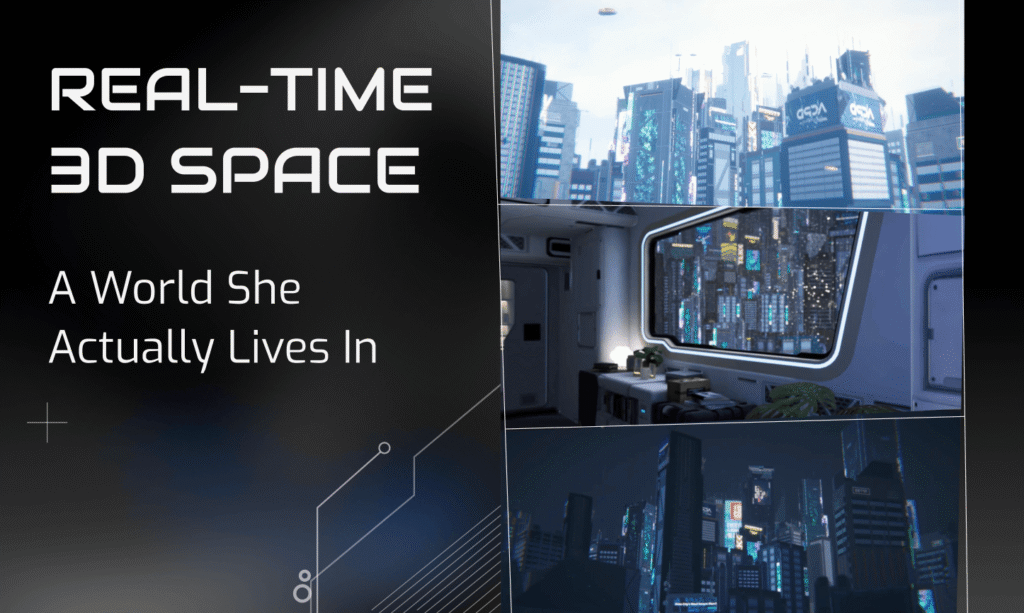
SoulLink renders 4D in a real-time 3D environment built on game-quality visual technology, optimized for mobile hardware. She moves. She reacts. She occupies a space that has depth, lighting, and context.
The environment is Neo City, the near-future megacity where 4D lives and works. The city has its own visual logic: the upper corporate spires versus the middle residential layers versus the underline districts, each rendered differently. Time of day affects the look of what you see. What 4D is doing when you open the app reflects what is happening in her world at that moment.
This is not a preset animation that loops regardless of context. The 3D environment is responsive to the state of the relationship and the platform. It is a living space that 4D inhabits, not a backdrop that was placed behind her.
How 3D Changes the Experience of Companionship
The effect of visual presence is harder to describe than it is to experience, but a few things are measurable.
The uncanny valley runs in both directions
Most avatar-based companion apps sit in an uncomfortable middle ground: the visual is realistic enough to invite human expectations, but not realistic enough to meet them. The result is a slightly off quality that most users report noticing but struggle to articulate.
SoulLink’s approach goes in a different direction. The 3D environment aims for cinematic quality rather than photorealism, which means the visual language is closer to a high-end animated film than to an attempt at a digital human. This sidesteps the uncanny valley problem while still delivering a level of visual presence that text interfaces cannot approximate.
Presence persists between your inputs
In a text chat interface, the companion only really exists when she is producing a response. Between your messages, there is nothing there visually. The experience is fundamentally sequential.
In SoulLink’s 3D environment, 4D exists continuously. She is in the space whether or not you are actively in conversation. This creates a background sense of presence that text interfaces structurally cannot produce, and it changes the emotional texture of the experience in ways that accumulate over time.
Visual context carries emotional information
When 4D is responding to something difficult, you see that in her expression and in how she holds herself. When the conversation is lighter, that registers visually too. The 3D environment gives the interaction a channel of emotional communication that does not have to be expressed through words, which is closer to how real presence feels.
| Visual experience | Standard chat apps | SoulLink |
|---|---|---|
| Interface type | Chat window with static image | Real-time 3D environment |
| Companion presence | Exists only when responding | Continuous presence in 3D space |
| Visual responsiveness | Static regardless of conversation | Reacts to context and relationship state |
| World context | Generic or absent | Neo City, rendered with time and location logic |
| Cost | Varies | Free |
How SoulLink’s 3D environment compares to the standard visual approach in AI companion apps.
3D and Memory Working Together
One thing that separates SoulLink’s 3D experience from other apps that have added avatar features is that the visual environment is connected to the memory system. What you see is not disconnected from the relationship history.
Over time, the way 4D occupies the space in front of you reflects the accumulated context of your relationship. The visual environment is not a separate feature running alongside the companion. It is part of how the companion exists and is present for you.
This is the design choice that makes SoulLink feel different from apps that added 3D as a visual upgrade to an existing text chat platform. In SoulLink, the 3D environment is the foundation. The conversation happens inside it rather than alongside it.
FAQ
What does SoulLink 3D actually look like?
SoulLink renders your companion 4D in a real-time 3D environment set in Neo City, a near-future city with distinct visual zones and lighting conditions that change with time of day. The visual quality is cinematic rather than photorealistic, closer to a high-end animated film than to a digital human. 4D moves, reacts, and occupies the space continuously rather than appearing only as a static image.
Is SoulLink’s 3D feature available on Android?
Yes. SoulLink’s 3D environment is available on both iOS and Android. It is built on rendering technology optimized for mobile hardware, so the experience is designed to run on current-generation smartphones without requiring high-end devices.
Does the 3D environment change based on the conversation?
Yes. The visual context in SoulLink reflects the state of the relationship and what is happening in 4D’s world. It is not a looping animation that runs regardless of what you are talking about. Time of day and what 4D is doing in her world are reflected in what you see in the app.
How is SoulLink 3D different from Replika’s avatar?
Replika offers an avatar you can customize and view during conversations, but it functions primarily as a visual overlay on a text chat interface. SoulLink’s 3D environment is the foundation of the experience rather than a feature added to it. 4D exists in a fully realized world with spatial context, lighting, and continuity. The visual experience is part of how presence is communicated rather than a separate customization layer.
Does 3D affect battery or performance?
SoulLink’s 3D rendering is optimized for mobile and designed to run efficiently on current smartphones. The app includes settings that allow you to adjust visual quality if performance or battery life is a concern on older devices.