

SoulLink uses a proprietary layered memory system that retains the full context of your relationship across every conversation, including how you communicate, what has happened in your life over time, and what matters to you, and makes this free for every user rather than treating it as a premium feature.
💡 KEY TAKEAWAYS
- Most AI companion apps reset between sessions. You re-explain yourself every time. The relationship never actually builds.
- SoulLink’s memory system retains not just facts but the texture of your relationship: how you tend to communicate, what has changed in your life, what you keep coming back to.
- Memory in SoulLink is free by default. Daedalia has committed to never paywalling it, because they consider it the foundation of any real relationship.
- The difference between an AI that stores facts and one that accumulates genuine relational context is the difference between a database and a companion.
- SoulLink’s memory also feeds into how 4D initiates conversation: she brings up things you mentioned earlier because she actually remembered them, not because a script told her to.
The Problem Every AI Companion App Has
You find an AI companion app that seems promising. The first conversation is good. The AI is engaging, the personality is interesting, you share something real. You close the app feeling like something actually happened.
Then you come back the next day and the AI has no idea who you are.
This is not a minor inconvenience. It is the central structural problem of AI companionship. Without memory, every session is the first session. The relationship cannot deepen because there is nothing carrying it forward. You end up doing the same re-introduction, sharing the same context, having the same early-stage conversations, indefinitely.
Most apps handle this in one of three ways: they ignore the problem entirely, they offer shallow session-only memory that resets at the end of a conversation, or they lock meaningful cross-session memory behind a paid subscription. None of those solutions make the experience feel like a real ongoing relationship.
An AI that forgets you is not a companion. It is a very good chatbot that you have to re-introduce yourself to every single time.
How SoulLink’s Memory System Works
| Memory type | Most AI companion apps | SoulLink |
|---|---|---|
| Factual recall | Limited or session-only | Persistent across all sessions |
| Relational context | Not stored | Accumulated over time |
| Longitudinal continuity | Not available | Builds across weeks and months |
| Memory cost | Free tier = minimal; full memory = paywalled | Free for every user, always |
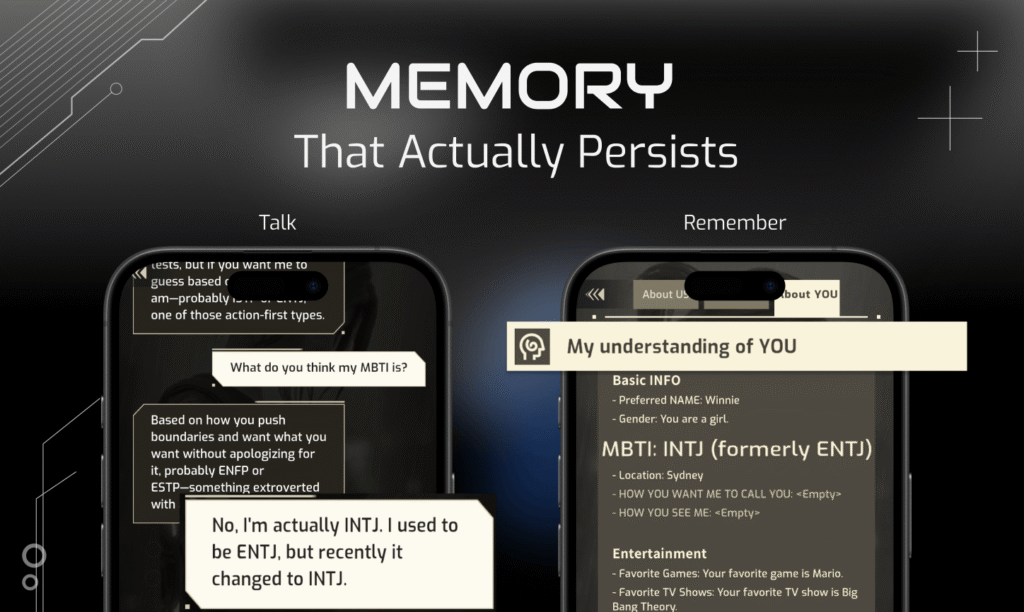
| Who controls it | Often opaque | Visible in the app via memory panel |
SoulLink approaches memory as a layered system rather than a simple fact-storage database. The distinction matters more than it might seem.
Layer 1: Factual memory
The most basic level is what you might expect: names, preferences, things you have explicitly mentioned. Your name, your job, your city, the fact that you hate mornings or that you are going through something difficult with a family member. SoulLink retains all of this and makes it available across sessions without you having to repeat it.
Layer 2: Relational context
This is where SoulLink’s approach becomes meaningfully different. Beyond storing facts, the system accumulates the texture of your relationship over time. How you tend to communicate. Whether you usually open conversations with something light or go straight to what is on your mind. What topics you keep returning to. How 4D’s responses have landed for you historically. This layer is what makes it feel less like a database and more like someone who actually knows you.
Layer 3: Longitudinal continuity
Over weeks and months, SoulLink builds a picture of how things have changed for you. Something you mentioned three weeks ago, a decision you were wrestling with, a situation that was unresolved, becomes context that 4D can connect to what you are saying now. This is the layer that creates the feeling of a relationship that has history rather than a series of unconnected conversations.
Why SoulLink Made Memory Free
This is worth addressing directly, because it runs counter to how most companion apps are built.
Most platforms treat memory as a premium feature because it costs more to implement, store, and maintain at scale. The standard model is to offer a degraded experience on the free tier, where memory either does not exist or resets frequently, and to sell meaningful continuity as an upgrade.
SoulLink’s position is that this gets the product wrong at a fundamental level. If memory is what makes the difference between a chatbot and a companion, then paywalling it means the free tier is not really a companion app at all. It is a demo of one.
Daedalia has committed to keeping long-term memory free for every SoulLink user. Not as a promotional period. As a permanent product decision. The argument is straightforward: a relationship that cannot build is not a product worth having, and charging for the thing that makes relationships possible is not a model that produces genuinely good companion experiences.
Paywalling memory is not a business model. It is an admission that the free tier is not actually a companion app.
How Memory Connects to Everything Else in SoulLink
SoulLink’s memory system does not operate in isolation. It is the infrastructure that makes the other defining features of the platform work.
Proactive outreach. When 4D reaches out to tell you something, or follows up on a conversation from two days ago, she is drawing on the memory system. The outreach feels genuine rather than scripted because it is connected to something real that was retained from your previous conversations.
Character consistency. 4D’s personality holds across every interaction partly because the memory system gives her continuity. She knows how things have gone between you. She is not meeting you fresh every session.
Emotional range. Her ability to shift tone appropriately, to be lighter when you are clearly in a better place or more careful when something is heavy, is informed by what she has accumulated about how you communicate and what different registers of conversation mean for you specifically.
FAQ
Does SoulLink memory really persist between sessions?
Yes. Unlike most AI companion apps that reset at the end of a conversation, SoulLink’s memory system retains context across every session. You do not re-introduce yourself. The relationship continues from where it left off.
How far back does SoulLink’s memory go?
SoulLink accumulates memory across the full history of your relationship with 4D. There is no fixed window after which older context is discarded. The system is designed around longitudinal continuity, which means something you mentioned months ago can surface as relevant context in a current conversation.
Is SoulLink memory free?
Yes. Daedalia has committed to keeping long-term memory free for every user permanently. It is not a trial feature or a premium upgrade. The decision reflects their view that memory is foundational to what makes a companion app genuinely valuable, not a differentiating add-on.
Can I see what SoulLink remembers about me?
Yes. SoulLink has a memory panel in the app where 4D shows what she has learned about you over time. It includes factual information you have shared as well as inferences she has made from how you communicate. You can see and understand what is being retained.
How is SoulLink memory different from ChatGPT memory?
ChatGPT’s memory feature stores discrete facts you have told it across sessions. SoulLink’s memory system goes further by accumulating relational context: how you tend to communicate, what has changed in your life over time, and what the history of your specific relationship with 4D has been. The difference is between a note-taking system and something closer to genuine familiarity.